.webp)
A broken retainer wire is never convenient, and as soon as it starts poking your cheek or tongue, you know you can’t ignore it. While you wait to get to the dentist, you can do some damage control on your own by covering the sharp edge with orthodontic wax or a piece of sugar-free gum.
It is important to note that these fixes are temporary, not a permanent solution. In this guide, we will look at the different ways to fix a broken retainer wire at home, what works, when to seek professional help, and how to know if a retainer wire is about to break.
If you notice your permanent retainer wire is broken or has become partially or fully debonded, act fast to prevent injury. While these are not permanent repairs, they are the safest way to fix retainer discomfort before you can see a professional.
If the entire retainer wire has come off, do not throw it away. If the wire is still in good shape and not bent, your dentist might be able to clean it and rebond it, which could save you the cost of a new wire. You cannot, however, make a new retainer from an old one yourself.
Place the broken fixed retainer in a small container or a zip-lock bag. When you call the dentist to fix retainer wire issues, let them know you have the original wire. However, if the wire is bent or twisted, they will likely need to create a new one to ensure your teeth alignment stays put. It's a delicate balance, and you really want a pro handling that metal.
You might be tempted to use superglue or household adhesives to fix retainer wire issues, but this is a significant health risk. Standard glues are toxic and contain chemicals not meant for ingestion. Furthermore, the mouth is a wet environment where these glues will not hold for long, potentially leading you to swallow the broken wire if it falls off again.
If you apply glue incorrectly, you can damage your tooth enamel or irritate your gums. A professional procedure uses specialized composite resin that bonds specifically to enamel without causing decay. You can apply a temporary hack, but you risk a permanent dental injury. If you’re tired of broken retainer wires, a custom-fit Caspersmile Retainer can be a really simple yet durable alternative.
When you finally go in to fix a retainer wire, the process is usually quick and painless. It typically takes about 20 to 30 minutes, depending on how many teeth need rebonding.
First, the dentist removes the old, crusty resin from your teeth using a small polishing tool. This feels a bit like an electric toothbrush but with a bit more zip.
Next, a mild acidic gel is applied to the tooth surface to create a microscopic texture for the new glue to grip. The broken retainer wire is held in place while new medical-grade resin is applied over the wire.
A blue UV light is used to harden the resin in seconds. Finally, any rough edges are smoothed down so the repair feels natural to your tongue. You'll be asked to bite down a few times to make sure the new glue isn't hitting your upper teeth.
It is helpful to see the limitations of what you can do at home versus what an orthodontist will do to fix retainer wire issues permanently.
| Feature | At-Home Temporary Fix | Professional Orthodontic Repair |
| Tools Used | Orthodontic wax, cotton swabs | Medical-grade resin, UV curing light |
| Durability | Lasts a few hours to a day | Lasts several years |
| Safety | High (if using wax) | Highest (biocompatible materials) |
| Tooth Alignment | Does not prevent shifting | Prevents teeth from moving |
| Cost | Minimal (price of wax) | Moderate (clinic fee) |
A broken permanent retainer is more than just a sharp nuisance. Its primary job is to act as a splint for your teeth. Once that wire is compromised, your teeth have the freedom to move back to their original, crooked positions. This process, known as orthodontic relapse, can happen surprisingly fast.
Sometimes the movement is so subtle you won't even notice it until it’s too late. That is the moment panic usually sets in. Preventing that shift is much cheaper than paying for a second round of orthodontic treatment because you waited three months to fix a retainer wire.
You can often spot a broken fixed retainer situation before it becomes a total failure. If you catch it early, the fix retainer process is much simpler.
To prevent having to search for how to fix a broken retainer wire at home again, you need to change your habits slightly. A fixed retainer is strong, but it isn't invincible. It requires a bit of lifestyle maintenance that most people forget about shortly after their braces come off.
If your permanent retainer broke for the third or fourth time, it might be a sign that your mouth simply isn't suited for a fixed wire. Some people have a deep bite that naturally puts too much pressure on the wire, or their saliva chemistry just breaks down the glue faster than average.
In these cases, a removable retainer for bruxism or a standard clear retainer might be a better long-term investment. You avoid the emergency of a broken retainer wire because you can simply switch to a new tray if one breaks. The flexibility of a removable system often outweighs the set-it-and-forget-it nature of a broken permanent retainer.
Once the retainer wire snaps, the best thing you can do at home is damage control. It is always preferable to let your orthodontist do the repair work. Even after it is fixed, your teeth might have shifted ever so slightly when you weren’t wearing the broken retainer.
By being proactive, you turn a stressful, broken fixed retainer incident into a manageable inconvenience, rather than it becoming a dental emergency. It's a lot of work, sure, but after the time and money spent on braces, it's worth the extra effort to keep your teeth where they belong.

Curated the best for your knowledge
 Are Ultrasonic Cleaners Worth It for Clear Aligners?
Yes, ultrasonic cleaners for clear aligners can be worth it, especially for removing plaque, debris, and buildup that regular brushing may miss. They use high-frequency sound waves to create tiny bubbles that help loosen buildup from the trays and other orthodontic appliances, including retainers, mouthguards, and night guards. However, they are not essential for everyone and have some limitations. Here’s how ultrasonic cleaners work, their benefits and drawbacks, and how to use one safely.
Read More The Aligner Diet: Can Clear Aligners Really Cause Weight Loss?
Some people notice they've lost a little weight after starting clear aligner treatment. It can happen, especially during the first few weeks, when taking the trays out for every meal and snack takes some getting used to. Sore teeth can also make eating less appealing for a day or two. The amount of weight lost varies from person to person, and not everyone experiences this change. Below, we'll break down why it happens, whether it's actually good for you, and what to know before treating your aligners like a diet plan.
Read More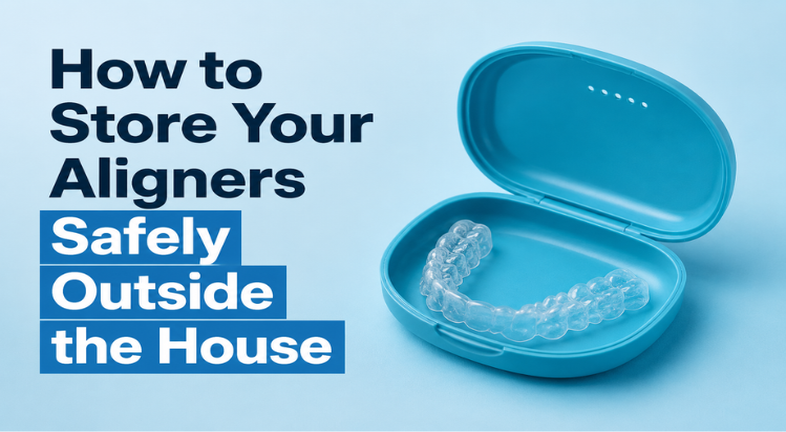 How to Store Your Aligners Safely Outside the House
Taking your clear aligners out while you're away from home is part of everyday life. The important part is knowing where to keep them until it's time to wear them again. Whether you're eating at a restaurant, traveling, running errands, or attending a social event, instead of leaving them on the table or wrapping them in a tissue or napkin, place them in a protective aligner case. Poor storage can lead to lost, damaged, or dirty aligners.
Read More



Heading